
What are Low Impact Workouts?
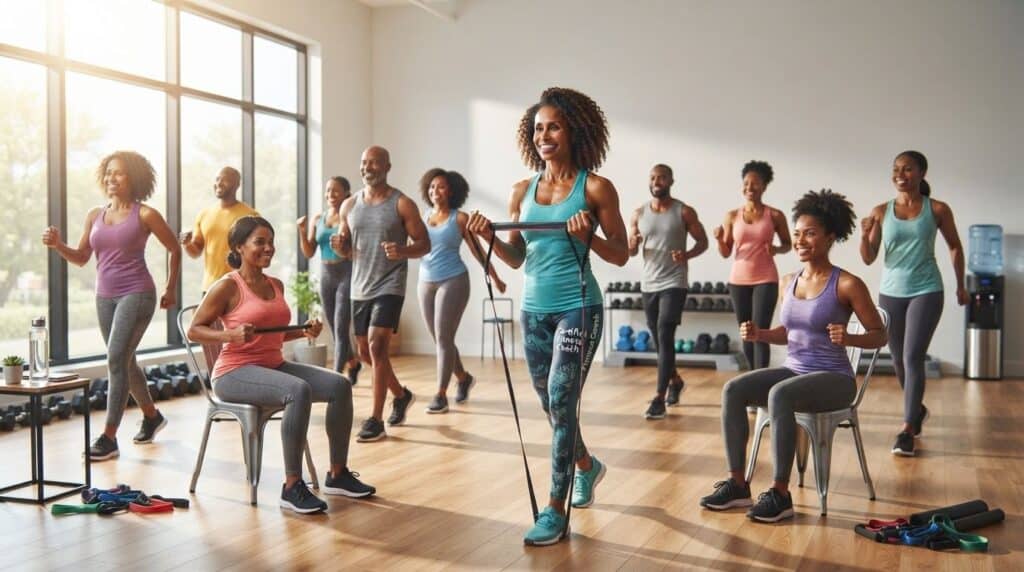
Definition of Low Impact Exercise
Low-impact workouts are controlled, fluid movements that reduce shock or impact on the joints like the knees, hips, and spine.
Table of Contents
To put it differently, any exercises that always put one foot on the ground are considered low-impact workouts, and they are good for beginners and those who are recovering from joint injury.
These exercises improve cardiovascular health, stamina, and strength.
How Low Impact Workouts Differ from High Impact Exercises
The main difference between low-impact and high-impact workouts is the impact or shock they exert on the joints.
As you may already know, low-impact workouts are exercises that have at least one foot on the floor, which promotes fluid movement that reduces shock to the joints. But high-impact workouts are exercises that have both feet off the ground simultaneously, thereby impacting the joints of the body upon landing back on the ground.
Below is a table that sheds more light as to the differences between low-impact and high-impact exercises.
| Features | High Impact Workout | Low Impact Workout |
| Mechanics | Hands/Feet leave ground simultaneously; instances of this type of exercise include burpee, jumping jack, etc. | A Hand/Foot remains in contact with the ground: instances of this type of exercise include cycling, walking, etc. |
| Joint Stress | This causes stress to the joint due to jolt and landing impact. | This does not cause stress to the joint due to the fluid movements that eliminate jolt and landing impact |
| Primary Benefits | This helps to burn more calories quickly, build and strengthens muscle, and bone mineral density | This is ideal for rehabilitation and staying consistent in a workout, and it also protects the joints. |
| Common Examples | Jumping jack, running, burpee, plyometrics, etc. | Walking, swimming, yoga, rowing, cycling, etc. |
Common Myths about Low Impact Training
- There is a common myth that low-impact training is low intensity or easy. No, the fact is that low-impact exercises such as swimming, rowing, and Pilates might be gentle to the joints, but they are physically demanding to execute and intense. They are highly effective for weight loss, building strength, and improving cardiovascular health.
- There is a common myth that low-impact training is only for beginners or those who are injured. Well, they are ideal for beginners and those undergoing rehabilitation due to injury, but not only for them. The reason is that professional athletes use low-impact workouts like cycling, rowing, and swimming for active recovery, cross-training, and muscle endurance.
- There is a common myth that low impact is not good for building muscle and bone density. That assertion is not entirely true. If you observe the table above, bone density building is ascribed to one of the high-impact exercise benefits and not low-impact exercises. Well, resistance-based low-impact workouts such as Pilates and yoga exert more stress on the muscles, which in turn impacts and strengthens the bone.
- There is a common myth that high-impact exercises burn more calories for weight loss. This is not entirely correct because weight loss is 60 to 70% driven by calorie deficit. In other words, with a caloric deficit and overall physical activity, a person will healthily lose weight, not necessarily engaging in high-impact workouts.
Benefits of Low Impact Workouts for Beginners

Gentle on Joints & Bones
Low-impact exercises offer a sustainable fitness gateway for beginners to start their fitness journey. Beginners will have one less problem to deal with when trying to improve their fitness level, and that is jarring joint stress.
In other words, beginners will be able to remain consistent in their pursuit of fitness goals because they will have a lower risk of musculoskeletal injury and less recovery time.
Build Postural Strength & Mental Health
Beginners will stand to gain some of the advantages that low-impact workouts such as yoga, Pilates, brisk walking, and flowy tai chi offer. These workouts help to build core and postural strength, and boost mental health.
Support Healthy Weight Management
Low-impact exercises are effective in weight management because they burn calories, build muscle, and improve metabolism while having minimal impact on the joints.
- 1 hour of brisk walking session burns 314 calories (about 25 minutes of running) for an average 160 lb person
- 1 hour of swimming (full body workout) burns 400 to 700 calories (about 56 minutes of running)
- Cycling, either outdoors or indoor cycling bike builds leg strength and burns calories with minimal stress to the knees
Improve Heart Health & Endurance
The consistent performance of low-impact exercise increases the heart rate, oxygen consumption, and generally strengthens the cardiovascular system.
It brings down blood pressure and resting heart rate, and improves muscular and aerobic endurance.
Brisk walking stimulates heart and lung functions. Cycling, outdoors and indoors, boosts blood circulation and lower-body mobility. Rowing provides full-body workouts that target several muscle groups in the body without stressing the joints.
Who Should Choose Low-Impact Workouts?
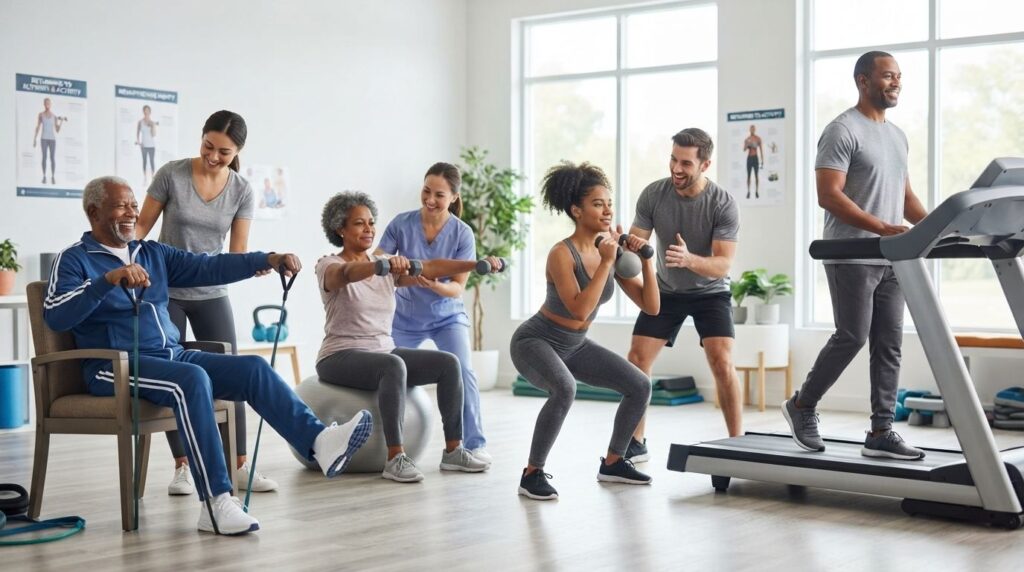
Complete Fitness Beginners
Low-impact workouts or exercises are best for complete fitness beginners for reasons earlier explained. These types of exercises allow total fitness beginners to feel comfortable pursuing their fitness goals. The reason is that there won’t be joint stress or even musculoskeletal injury that might impede or discourage them from continuing their fitness goals.
Thus, they will remain consistent and get to the level where they will be comfortable including high-impact workouts in their regimen when necessary.
Older People
Older adults are another category of people that would find low-impact workouts ideal for them. The reason is that their aging joints would not be exposed to harsh or jarring stress that comes with high-impact workouts.
They will be able to improve their cardiovascular health and muscles while protected from joint injury.
Low-impact workouts such as yoga and Pilates improve posture and balance, hence good for older people. Moreover, they improve bone density, mood, and brain power.
People Recovering from Injury
Low-impact workouts are therapeutic for those undergoing rehabilitation due to injury. In other words, minimal stress on their joints helps them to go through the process of recovery without much pressure to give up.
Also, low-impact exercises protect recovering joints from harsh impacts that usually occur in high-impact workouts. Hence, there will be quick progress in recovery.
Individuals With Joint Pain & Arthritis
This category of people is the same as those recovering from injury, since they both must deal with weak and painful joints. Thus, low-impact workouts come in handy for gentle recovery and improved overall well-being.
Anyone Returning to Exercise After a Long Break
Low-impact exercises give those returning to workouts after a long break the opportunity for their body to gradually be ready to do the exercises they used to do in the past.
Redid return to workouts after a long break can be a bad idea because the body has changed over the period of time they have been on break. Hence, there will be joint and muscle stiffness that will require low-impact workouts to unravel and condition them for high-impact workouts.
How to Prepare Before Starting Low Impact Workouts
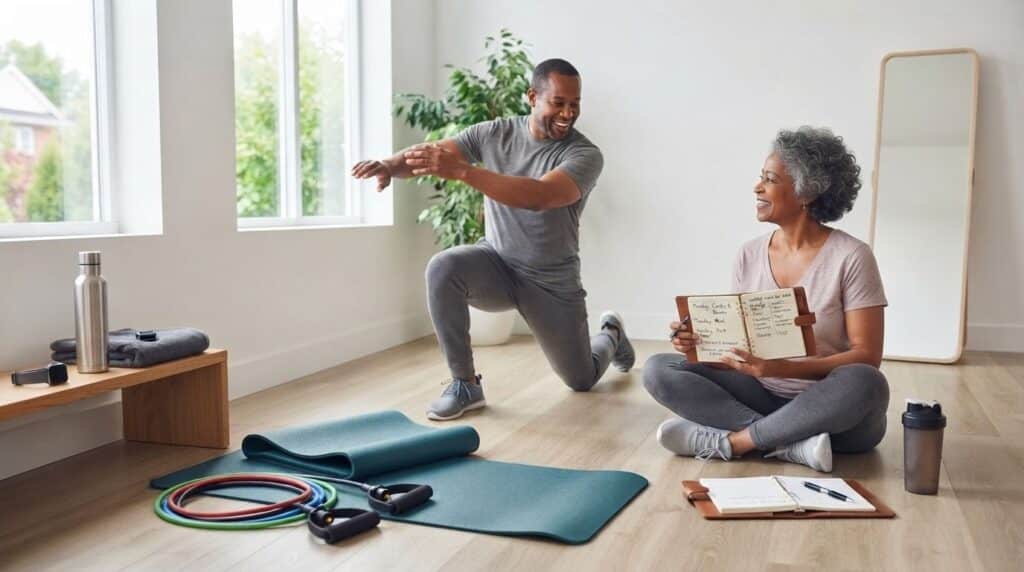
Wear Comfortable Clothing and Supportive Shoes
It is important to gear up in comfortable clothing and supportive shoes before engaging in low-impact workouts because they provide balance and a full range of motion without hindrance. In other words, they prevent clumsiness and help to properly execute workouts.
Here are some of the advantages of wearing the right clothing and shoes for workouts.
- Proper gear allows free movement
- Proper gear prevents injury, blisters, and muscle strain
- Proper gear improves dryness and coolness
- Proper gear reduces chances of accident, thus improving safety
Warm Up Your Muscles Properly
Warm up before low-impact workouts gets your body ready for the physical activities to be undertaken. For instance, warming up raises the core of the body and improves blood circulation, especially to the muscles.
Let’s just say that warming up the body is the lubrication process that gets the muscle tissues elastic and the joints fluid.
Ultimately, warm-up prevents exercise-related injury and improves mental alertness and body efficiency.
Set Realistic Fitness Goals
Setting realistic goals sets your fitness journey on the right path because you won’t be pressured to outdo or go ahead of yourself.
Unrealistic fitness goals can cause several problems that can ultimately end your fitness quest. It can cause injuries, discouragement, inconsistency, and finally abandonment of your fitness goals
On the other hand, when you set realistic fitness goals, you will be able to build daily healthy workout habits one at a time, stay motivated and consistent, prevent injury, and finally, see positive results and achieve your fitness goals.
Stay Hydrated Throughout Your Workout
Plan and prepare to stay hydrated throughout your workout because it helps your body to function properly.
See water in the body as an oil in a car engine. When you keep your body properly hydrated, the joints and muscles will be in better shape. The heart will also work better, allowing you to perform better.
Sip water before, between, and after workouts.
Best Low Impact Workouts for Beginners
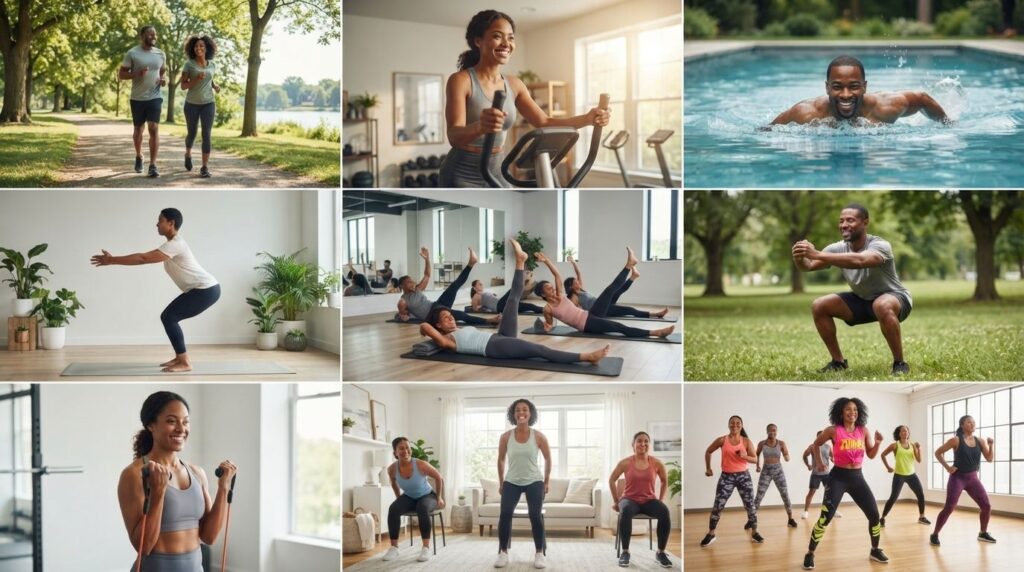
Walking
Brisk walking is one of the best low-impact workouts for beginners. It is simple, leisurely, effective, and can be fused into your normal daily activities without problem. It can be performed outdoors or even on a treadmill while watching TV or working on a laptop.
Swimming and Water Aerobics 8uj09
Swimming is one of the best low-impact workouts that has minimal impact on the joints. It also provides a full-body workout that activates and puts most muscle groups to work during exercise.
Cycling
Primarily, cycling does not put stress on the joints like when you are running. Secondly, it is best for burning calories and toning lower body muscle groups. It can be done indoors or outdoors; hence, it is convenient to execute.
Yoga and Pilate
Yoga and Pilates are good for beginners because they build core strength and flexibility without stress on the joints. They are exercises characterized by bodyweight, slow, and graceful movements that eliminate any jarring effect on the joints but improve balance and mental focus, all of that without equipment.
Bodyweight Strength Training
There are three distinct reasons why bodyweight strength training is one of the best low-impact workouts for beginners.
First, it does not require any equipment to perform it. Second, it is almost safe to execute; that is, low chances of getting injured. Third, it helps you to build the foundation you need before going on to lift heavier weights.
In other words, it is safe, requires only you and a space to perform, and builds up your strength and muscle.
Moreover, bodyweight strength training is customizable because beginners can adjust the difficulty of the workout to suit them. For instance, if a floor push-up is too hard or challenging for you, you can choose to start with a wall push-up or even knee push-ups.
Elliptical Machine Workouts
Elliptical machine Workouts are way gentler on the joints, such as the knees, back, and hip, than stationary bikes. The reason is that they mechanically mimic the natural human movement. They are smooth in operation and have great and secure support for the feet.
Most of these elliptical trainers support full-body workouts, targeting multiple muscle groups in the body simultaneously.
Also, it offers the opportunity for you to train at your own pace. The resistance system serves this purpose; you can increase or decrease your workout difficulty as you see fit.
Some good elliptical trainers are affordable, compact, and transportable.
Chair Exercises
Chair exercises are ideal for beginners because they are safe, simple, and effective. They have reduced chances of causing an accident or getting injured, and they are good for the joints.
Once you have a sturdy and steady chair, you are good to go. Hence, they can be performed anywhere and at any time.
These exercises are customizable because you can increase or decrease difficulty by positioning your body in a certain way.
Resistance Band Workouts.
Resistance band workouts are good for beginners for these reasons.
- Resistance bands are affordable and available on Amazon
- They provide safe and controlled resistance for effective fitness results, hence customizable
- They are joint-friendly
- Don’t require too much space
- Can provide full-body workouts
- Easy to carry around
Low Impact Dance Fitness
First and foremost, unlike running or jumping, this exercise protects the joints from jarring shock that may result from landing on both feet at the same time during a workout.
Simply put, low-impact dance fitness is essentially gentle on the joints and perfect for beginners and seniors. It is great for improving balance, coordination, mental alertness, endurance, and energy.
Moreover, it is a kind of exercise that you do and enjoy at the same time because it is fun to do, especially if you love dancing.
Beginner-Friendly 20-Minute Low-Impact Workout Routine
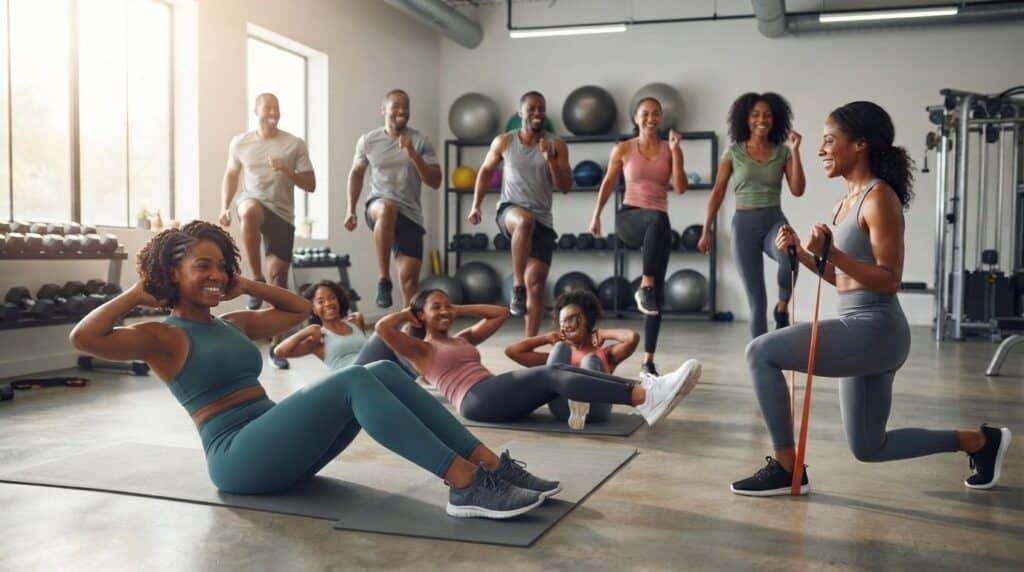
Below are beginner-friendly 20-minute low-impact workout routines that can help you smoothly start your fitness journey.
Five-Minutes Warm-Ups
Warm-ups are important not only for beginners but for everyone who wants to exercise. These warm-ups wake up or activate the body from a resting state to active conditions for workouts.
They boost blood circulation and prepare the muscles and joints to better handle exercises, hence preventing workout-related injury.
These are some of the reasons warm-ups are important for beginners.
- Warm-ups prevent injury, pull, or tear because they boost blood circulation to cold muscles.
- Warm-ups lubricate the joints. Someone likens them (joints before warm-ups) to dry and stiff door hinges that squeak when opening a door. But when lubricated, they function smoothly and effectively, and so do the joints of the body.
- Good warm-ups improve the range of motion of a beginner. They (beginners) often have tight muscles due to a lack of exercise for a long period of time. So, warm-ups stretch the chest and the hip to better and safely perform exercises like squatting with correct posture.
- Warm-ups activate the nervous system. They stimulate the brain to effectively communicate with the muscles so that they can be ready. Adapt and respond to the workouts that are about to come after the warm-ups.
- Warm-ups also get you to the mental zone where you are ready to work out to achieve a fitness goal. In other words, they give you that focus, motivation, and readiness you need to be a go-getter, in this case achieving your fitness goals.
Main Cardio Exercises
Main cardio exercises are essentially cardiovascular workouts that raise the heart rate and get blood pumping.
The main cardio exercises for beginners include low-impact exercises such as-
- Brisk Walking: quickens your breath as you walk at a consistent pace for a period of time.
- Standing Oblique Crunches: are a perfect low-impact exercise for beginners because they are easy to perform and can be done at home and without equipment. Click here to see how it’s done.
- Side Steps: This is easy and effective, hence good for beginners. This is done by simply standing and slightly squatting, moving two to three steps sideways and then doing the same toward the other side while your arms are in akimbo or held together in front of you or swinging your arms. This exercise strengthens your lower body, improves hip mobility, engages core muscles, and boosts your balance and coordination.
- Marching in Place is raising and lowering your knee and the opposite arm simultaneously and doing the same to the other knee and opposing arm as well while in place.
These exercises are good for beginners because they are effective, low-impact, easy, and require no gear.
Strength and Core Exercises
This is a core stabilization exercise for beginners that leads to proper body control. The strength and core exercises teach the body how to protect the spine so that beginners can easily do everyday tasks like lifting groceries or tying a shoe effortlessly.
Examples of strength and core exercises for beginners include bodyweight squats, the bridge, and the plank exercises.
Cool Down & Stretching
Cool down and stretching exercises are recommended to be done at the end of a workout session because they bring down the heart rate, prevent injury, and help the muscles recover faster.
Adhering to doing these exercises helps beginners to build a safe exercise habit they can stick to long term.
Tips for Staying Consistent with Low-Impact Exercise

Create a Weekly Workout Schedule
A weekly workout schedule helps beginners commit to exercising when they are supposed to. If they are consistently adhering to their workout schedule, it becomes a habit that will translate to a laser-focused ambition to achieve their fitness goals.
A good weekly workout schedule removes decision fatigue, prevents over-training, builds healthy exercise habits, and tracks progress.
Start Slowly & Increase Intensity Gradually
Beginners starting slowly and increasing intensity gradually helps their body, such as the muscles, tendons, and joints, safely adjust to new physical stress.
This approach allows beginners to build sustainable daily healthy workout habits even as they stay safe from injuries like strains and sprains.
This also prevents over-stressing the body and instead gives the body enough time to recover between sessions.
Starting slow allows you to learn the proper form of executing exercises. There is what is called neuromuscular efficiency, which means the ability of the brain and the muscles working and communicating together. But as a beginner, this does not happen. Hence, slowly starting workouts allows the body to go through the learning process of the brain and the muscles working in tandem.
Moreover, the joints, ligaments, tendons, and muscles are protected from wear and tear if, as a beginner, you start slowly and gradually increase workout intensity.
Finally, this technique prevents burnout because you are starting slowly and gradually increasing intensity. No overwhelming stress or pressure will be felt.
Common Mistakes Beginners Should Avoid
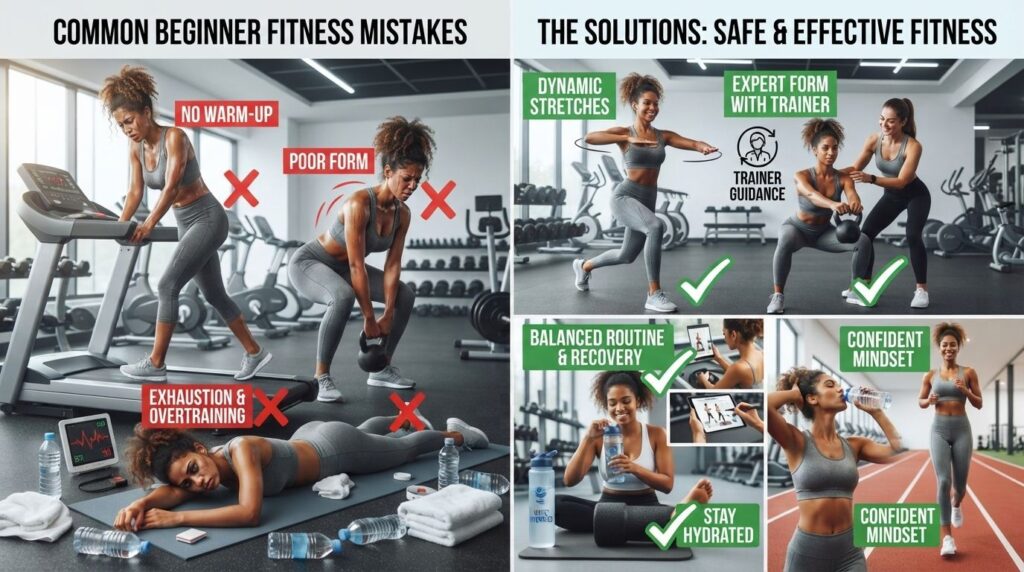
Skipping Warm-Ups & Cool Downs
Skipping warm-ups and cool-downs is especially not a good idea for beginners because their body system has not been used to exercise. Thus, they have a high chance of experiencing injuries like sprain, strain, dizziness, and even more after an exercise session.
Just to be clear, seasoned athletes are not getting a pass either when it comes to warm-ups and cool-downs. It is to their advantage and safety to adhere to this.
Doing Too Much Too Soon
Doing too much too soon is often a mistake beginners normally make. They are excited at the beginning and want to see significant results in a short period of time. This often leads to injuries and burnout that could ultimately end their desire to continue pursuing their fitness goals.
Doing too much includes lifting heavyweights they don’t have business with, exercising longer than they should in a session (60-90 min.), ignoring pain in their body, and skipping resting day(s)
Ignoring Proper Form
Ignoring proper form can lead to an injury and even shift the work away from target muscles. This means the person is literally sabotaging their effort to achieve any meaningful gain.
Therefore, beginners must follow proper form to prevent injuries, get positive results from their workouts, and ultimately build a strong foundation for realizing their fitness goals.
Comparing Yourself to Others
Beginners comparing themselves to others have compounding problems because they will be trying in a few weeks to be like someone who has put in five years of work. This is an unrealistic goal that might drive them not to adhere to proper form, exercise too much, or skip rest days just to see a quick result.
But you know what happens, right? Yes, burnout, frustration, and finally give up when fruition is not on the horizon.
Nutrition Tips to Support Low Impact Training

Eat Balanced Meals for Energy
As a beginner, include in your meal the trio of macronutrients, which are protein, carbohydrates, and fat for energy, because you need all the energy you can get to succeed.
Prioritize Protein for Recovery
Eat more protein for quick recovery of the muscles. As a beginner, you will be experiencing more muscular pain than someone who has been exercising for years.
So, aim to eat 1.4 to 2.0 grams of protein per kg of your body weight daily. The reason is that protein provides amino acids that are the building material the body uses to patch up the cracks in your muscle tissues so that you can grow stronger and better.
Stay Hydrated Before & After Workouts
Staying hydrated before, during, and after workouts goes a long way to make a workout session productive. Hydration literally helps to manage your body’s temperature, up your energy, and prevent muscle cramps.
Healthy Snacks for Active Beginners
As a beginner, you can’t snack on anything snackable. You must consciously choose healthy snacks to keep and sustain your fitness journey rhythm.
The best beginners’ snacks are simple and easy-to-digest whole foods such as Greek yoghurt, apple slices with cheese, and banana with peanut butter.
Frequently Asked Questions (FAQ)
Can Low-Impact Workouts Help with Weight Loss?
Yes, consistent low-impact workouts help with weight loss. They are actually gentle on the joints while they help to improve metabolism, burn calories, and build lean muscles.
How Often Should Beginners Do Low-Impact Workouts?
Ideally, beginners should do three to four days of 20 to 40 minutes of workout sessions per week. This workout arrangement helps beginners work out effectively while having time out for resting. Hence, promoting a sustainable, consistent, and injury-free fitness journey.
Are Low-Impact Workouts Effective for Muscle Building?
Short answer: yes, but it has to be done through an approach called progressive overload. This means a gradual increase in weight or resistance when necessary. This is done with the combination of additional outside weights other than bodyweight.
For instance, equipment such as dumbbells, kettlebells, and resistance bands comes in handy for muscle building with low-impact workouts.
So, low-impact workouts are effective for muscle building.
Can I Do Low-Impact Workouts Every Day?
Unlike high-impact workouts (running or jumping jacks) that require a day or two off for bones and joints’ recovery, low-impact workouts are gentle on the knees, hips, and back. Thus, it is possible to do low-impact workouts every day.
Nevertheless, include low-intensity low-impact workouts in your regimen to reduce fatigue, and adhere to healthy habits of eating balanced diets, maintaining proper hydration, and do not exceed the recommended 150 minutes of workouts per week.
What Equipment Do I Need to Get Started with Low-Impact Workouts?
You can get started with low-impact workouts anywhere you are comfortable, such as in your home or any local gym around you.
The basic equipment you may need is a yoga mat, resistance bands, and supportive gym shoes.
If you wish to step up your game, you may consider getting an elliptical trainer, a stationary bike, or a rowing machine.
Conclusion

Low-impact workouts are those exercises that keep at least a hand/foot on the ground during execution; hence, they are gentle on the joints and the bones.
Building a healthier body does not need major lifestyle changes or an expensive gym. Engaging in low-impact workouts such as brisk walking, water aerobics or swimming, yoga, pilates, cycling, rowing, push-ups, and chair squats can go a long way to transform your health.
Doing these a few minutes a day, three to four days a week, can be transformational.

I take anything and everything that improves my health seriously. Hence, I try to share my knowledge to help people who wish to improve their health status to one that enables them to live strong with confidence We also review health and fitness equipment such as treadmills, elliptical trainers, spin bikes.