
Introduction

It is completely possible to build muscles at 40. Some people in that age bracket might think that they have passed their prime; therefore, it will be useless to try to build muscles.
Table of Contents
On the contrary, they can build muscles, boost their metabolism, joint health, and bone density.
However, they must prioritize certain workouts such as joint-friendly compound movements (dumbbell workouts instead of barbells), start with light weight and gradually increase the weight as they get stronger, eat 0.7 grams of protein per pound of their body weight, and take recovery workouts seriously.
Why Building Muscles After 40 is More Important Than Ever
People at the age of 40 or more will naturally experience age-related muscle loss that is also known as sarcopenia. Hence, it is important to engage in activities such as strength training to counteract those processes.
Another reason for an active lifestyle for people at 40 is to maintain a healthy weight while building lean muscles, improving metabolism by increasing their RMR (Resting Metabolic Rate) to prevent visceral belly fat, something that is very common with older people.
Resistance training helps to boost bone density as it is subjected to mechanical stress during workouts. This reduces the risk of bone fracture or osteoporosis that may happen later in life.
Also, muscle mass enables the body’s ability to regulate blood sugar, thereby reducing the risk of developing type 2 diabetes.
Can You Still Build Muscles After 40?
Although your body cannot produce testosterone and recover from injury as it once could in your 20s, it is possible to build muscles after 40.
Studies have shown that older individuals can build muscles and retain them through consistent and right choices of strength training and good diets. Eat more protein and aim for 7 to 9 hours of quality sleep.
Why your sleep quality and duration are important is because that is what makes or breaks your testosterone level, which is responsible for driving muscle protein synthesis, fueling strength output, speeding up recovery, and keeping your training momentum alive. So, prioritize quality sleep.
Train smarter; as mentioned earlier, opt for compound strength training such as squats, deadlift, and presses. The article I wrote earlier, Beginners Dumbbell Workouts, is relevant and will help immensely in this subject.
For joint care and reducing the risk of muscle soreness and injury, always engage in warm-ups and cooldowns before and after every workout session.
Why Muscle Mass Declines After 40
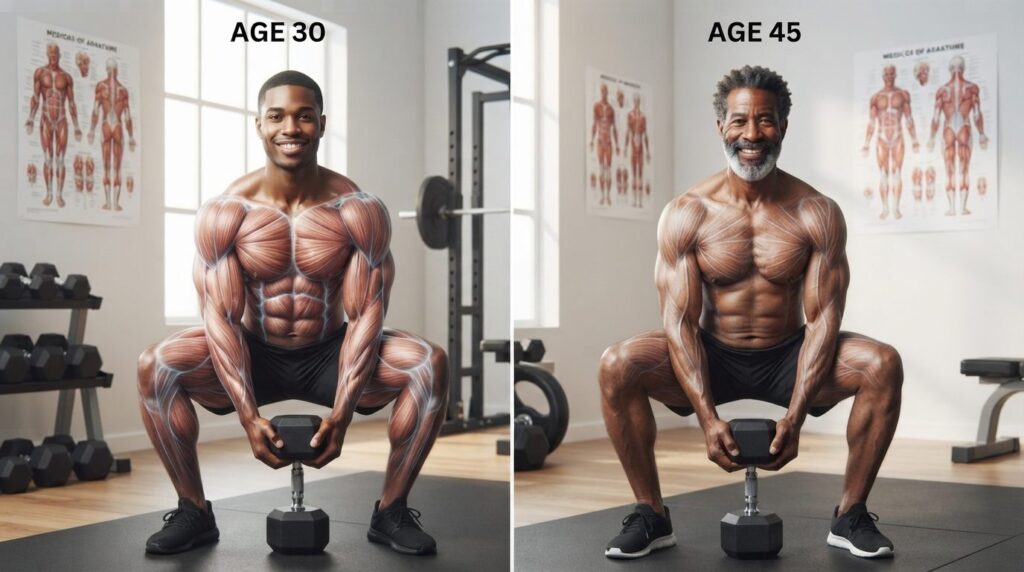
Understanding Age-Related Muscle Loss (Sarcopenia)
Sarcopenia is a natural occurrence that must be experienced by everyone as they age. It is the age-related decline in muscle mass, strength, and function. This begins to creep in as we age. Typically, by the ages of 30s and 40s, we will begin to lose 3% to 8% of muscle mass every decade, and this process is called sarcopenia.
Sarcopenia affects are accelerated after 60 years of age.
The scientific explanation for sarcopenia is the decline of testosterone and hormonal shifts as we age.
Some of the common symptoms that are usually associated with sarcopenia include imbalance and falls. However, sarcopenia can be reversed or delayed by exercise and diet, as a sedentary lifestyle expedites progress.
How Hormonal Changes Affect Muscle Growth
Anabolism is the body process of building muscles, and catabolism is the process of breaking it down, and hormones determine the shift between these two processes in the body.
Cortisol, the stress hormone, degrades muscles if left chronically unchecked, while hormones like testosterone, growth hormone (GH), and insulin-like growth factor (IGF-1) are the major drivers that promote protein synthesis and tissue repair.
Lifestyle Factors That Speed Up Muscle Loss
The lifestyle factors that speed up muscle loss (sarcopenia) include a prolonged inactive lifestyle, inadequate intake of protein, poor sleep habits, and drastic crash dieting.
- A prolonged, inactive, or sedentary lifestyle will often lead to muscle loss. When the large muscle groups in the body are rarely put into use, these signals to the body that they are not needed, hence, rapid muscle loss. So, it will be appropriate to say the principle of ‘’use it or lose it’ is applicable here.
- Muscle repair and growth heavily rely on protein, and when this is in short supply (not consuming enough protein), the body will not be able to maintain the muscles, hence muscle loss. Let’s put it differently: amino acids, especially leucine, which is a building block of protein, promote healing and growth of the muscles after exercise. But when there is not enough protein to go round, muscle loss will occur.
- As aforementioned, cortisol is a hormone that is harmful to muscle growth, and poor sleep quality can make tons of that. So, chronic stress and poor sleep can negatively impact muscle growth.
- We know that calorie deficit weight loss technique effectively burns fat, but when it is done in a drastically restrictive dieting approach to lose weight quickly will often not only burn fat but also muscle mass.
Benefits of Preserving Lean Muscles
The benefits of preserving lean muscles have been proven to be real and true with evidence. It will suffice to say that lean muscles are the foundation of a healthy lifestyle and functional independence, because they promote metabolism, blood sugar regulation, and reduce the risk of osteoporosis and chronic diseases such as type 2 diabetes.
Can You Build Muscle Naturally After 40?

After 40, hormones like testosterone decline by 3% to 5%, or maybe 8% (although this process accelerates by age 60) every decade, but your body still retains the ability to build muscle. So, yes, you can still build muscles and retain muscle tissues naturally after 40.
The Science Behind Muscle Growth at Any Age
At any age, the biological principle of muscle growth is still the same regardless of age. However, the biological changes over time in older individuals might make the process of building muscles a bit slower but not impossible.
Through targeted resistance training, adequate protein intake, quality sleep, and an overall healthy lifestyle, anyone can build muscles.
Common Myths About Building Muscles After 40
The common myths about building muscles after 40 include ‘it is too late to start lifting weights. This is so untrue and has been proven to be false.
The truth is that your body is biologically still capable of adapting and building muscles. Consistent strength training with progressive weight increase and good nutrition can counteract sarcopenia (age-related muscle loss).
Another myth: The older you get, the more dangerous lifting heavy weights is for you. This is a myth because if you perform your strength training with proper form and weights and progress to lifting heavier weights with time, this protects and strengthens your joints. Putting healthy stress on the muscles through lifting appropriate and challenging weights improves bone density and makes connective tissues resilient.
Another myth: Older individuals cannot build or grow their muscles because of the reduction of testosterone or other hormones. This is not correct. As stated earlier, strength training, good diets, and quality sleep actually reverse or counteract this process of sarcopenia (age-related muscle loss caused by the reduction of testosterone).
Another myth: Older people need to work out every day to see results. No, on the contrary, your body takes a little longer to recover or heal as you get older. So, you will have to train smart and rest for recovery and better results. Therefore, go for 2 to 3 strength training workout sessions a week. This must be every other day, giving room for a rest day in between.
How Long Does It Take to See Results?
Typically, adults at 40 and beyond can start experiencing strength increases in 2 to 4 weeks of strength training. Visible muscle definition will begin to manifest in 6 to 12 weeks (about 3 months), while major physique changes may happen in 3 to 6 months.
Remember, consistent smart strength training, good nutrition, and quality rest are keys to achieving your muscle-building goals at age 40 and beyond.
Nutrition for Muscle Growth After 40

Eat Enough High-Quality Protein
Aim for 1.2 grams to 2.0 grams of high-quality protein per kg of body weight. Essentially, you may need 30 grams to 40 grams of protein per meal depending on your weight, and try to spread the intake evenly across your meals, which may be three to four times a day.
It is recommended to eat at least 30 grams of high-quality protein at a sitting because older people need more protein than their younger counterparts to trigger muscle protein synthesis. In other words, this approach will overcome age-related resistance to muscle protein synthesis.
Increase Calories the Healthy Way
The body needs plenty of healthy calories to develop in terms of muscle building and strength for workouts. Hence, take healthy foods in surplus, up to 300 to 500 calories a day. However, make sure that a big part of those calories is high-quality protein.
Foods that are rich in high-quality protein and amino acids include eggs, chicken, Greek yoghurt, fish, and whey protein. Other healthy foods include fats (avocados, extra virgin olive oil, raw nuts and seeds, fatty fish, and plant oils). Healthy carbohydrates include quinoa, oats, brown rice, sweet potatoes, pumpkin, apples, bananas, berries, and more.
The combination of these healthy foods provides the fuel you need for sustained, good, productive training performance and muscle building, repair, and healing.
Choose Complex Carbohydrates for Energy
The best healthy carbohydrates to prioritize would be the complex ones such as whole grains (brown rice, oats, and quinoa); these provide high fiber and vitamin B. Legumes (beans, lentils, and chickpeas); these provide plant-based protein, minerals, and soluble fiber. Then you have starchy vegetables (sweet potatoes, yams, and squash); these provide energy accompanied by vitamins A and C.
The reason to focus on consuming complex carbohydrates is that they make you feel full and are slow to digest, which means long, steady energy. They also prevent rapid highs and lows in your blood sugar, and finally, they are full of nutrients like vitamins and minerals.
Include Healthy Fats for Hormone Support
Healthy fats are responsible for building anabolic hormones like testosterone and estrogen, which are the hormones that unfortunately decline after the age of 40. So, consuming 25% to 35% of daily calories from healthy fats can boost hormone production.
Healthy fats support joint strength and boost fast recovery by controlling systemic inflammation.
The best fats can be derived from fatty-fish food like salmon, mackerel, and sardines (omega-3 fatty acids), walnuts, and flaxseeds. These positively and greatly reduce inflammation and enhance insulin sensitivity.
Others include monounsaturated fats such as avocados and extra virgin olive oil, which are very good at supporting estrogen and testosterone balance while making sure that the heart is healthy.
Lastly, saturated fats. These include grass-fed meats (consume in moderation) and whole eggs. They give the body the right building blocks to make important sex hormones.
Stay Hydrated for Better Performance
In general, proper hydration improves overall well-being. Specifically, it enhances performance, muscle growth (by improving protein synthesis), and nutrient delivery when combined with good nutrition.
In other words, staying hydrated is instrumental in preventing age-related muscle breakdown.
Why hydration is important, especially to those who are over 40, is because muscles are made up of 75% water. So, proper hydration swells cells and triggers anabolic growth pathways.
Naturally, as a person ages, their thirst cues are reduced; therefore, it is important to make intentional decisions to drink water regularly to prevent accelerated muscle protein breakdown.
Best Vitamins & Minerals for Muscle Growth
As the body ages, people over 40 will need the essential minerals and vitamins that would improve hormones, muscle contraction, and speed recovery. Some of these macronutrients are Magnesium, Vitamin D3, and Zinc.
Now, some of the minerals include Magnesium (this reduces stress hormones (cortisol), regulates muscle function, and helps protein synthesis), Zinc (this boosts healthy testosterone and expedites tissue repair), and Calcium (promotes and preserves bone density and aids proper muscle contraction).
The Vitamins needed include Vitamin D3 (this helps to boost testosterone production, muscle strength, and bone), Vitamin C (this basically fights oxidation; in other words, it serves as an antioxidant that prevents muscle cell damage, and helps the production of collagen, and hormones), and Vitamin B-Complex (helps in red blood cell production during intense workouts and also boosts energy metabolism).
Best Strength Training Exercises After 40

Focus On Compound Workouts
Best strength training exercises for those who are over 40 would be compound exercises such as dumbbell rows, box squats, kickstand deadlifts, reverse lunges, neutral-grip bench press, and overhead press.
These compound workouts target multiple muscles at once, protecting joints while improving core and balance. They are mostly done with dumbbells, which are good for beginners and older people alike because they give users control over their workout movements and do not allow stronger arms to help the weaker arm when lifting, hence balancing physique.
Add Isolation Exercises for Balanced Development
Just as aforementioned, dumbbell workouts help to balance muscles and physiques. Thus, the isolation exercises recommended are lateral raises, leg extension, dumbbell bicep curls, triceps cable pushdowns, rear delt flyes, seated leg extension, prone hamstring curls, and standing calf raises.
Those are upper and lower body isolation exercises that can help individuals who are above 40 years old build muscles with low risk of injury, perform in correct form, and achieve balanced muscle and physique development.
Why Progressive Overload is Essential
What is progressive overload? Progressive overload is a situation where those who perform strength training try to gradually increase the weight they lift, time, sets, and repetitions as their strength improves.
So, what this does is that it helps fight the deterioration of the muscles (age-related muscle loss also known as sarcopenia), and this is why it is essential to embrace this fundamental training principle.
Beginner-Friendly Weekly Strength Routine
People who are over 40 years old will stand a chance of succeeding in their muscle and strength development goal if they can adhere to a viable beginner-Friendly weekly strength routine.
This is the deal, I mean, beginner-friendly weekly strength routine. Perform full-body workout sessions for 3 days a week. The workout session days have to be every other day so that you can rest between the days. So, let’s say workout days are Monday, Wednesday, and Friday.
There are several strength training workouts you can start with, but you may start with these:
- Goblet Squats
- Incline Dumbbell Presses
- Dumbbell Romanian Deadlift
- Dumbbell Rows
- Planks
Cardio Without Losing Muscle

How Much Cardio is Enough?
For folks who are over 40, and especially trying to build muscle, 60 to 150 minutes of moderate-intensity cardio workouts per week will be just fine. These can be split into short workout sessions to burn fat and keep your heart healthy without losing your hard-earned muscles.
Keep it moderate by taking a brisk walk, using an elliptical machine, recumbent cross trainer, or a stationary bike. Exercise at a pace where you can talk but are not able to sing.
If possible, do your cardio workout sessions on a different day, or hours after your strength training. Reduce the amount of time you spend on your cardio workouts if your joint hurts, or if your strength drops.
If you must do strength training and cardio workouts the same day, always do strength training first so that you may have enough energy to lift weights.
Best Low-Impact Cardio Options
Older people over 40 must engage in workouts that don’t impede the success of their fitness goals. They can’t sprint simply because someone does that, no.
They should train smartly and perform low-impact workouts at a level that won’t break them or make them lose muscle. Below are some of the best low-impact cardio options they might consider adding to their workout regimen.
- Stationary bikes or Outdoor cycling: This is one of the best low-impact cardio exercises that can elevate your heart rate without hurting your joints.
- Rowing Machine: This is a low-impact cardio workout that targets multiple muscle groups in the body because it provides full-body exercise without stress to the joints, and you can decide how challenging your workout can be.
- Treadmill: You can decide to brisk walk outdoors or on a treadmill, especially the one with an incline system. This will allow you to walk at a 3% to 5% incline so that not just the leg muscles will be engaged but also the glutes and calves.
Balancing Cardio & Strength Training
It can be overwhelming to have to do strength training and cardio exercises in a week, and balancing them both can be demanding if you don’t have a working plan.
Now, this is the formula: prioritize strength training, limit high-impact cardio, and allow extra recovery time.
Start with strength training, keep cardio short, and eat plenty of high-quality protein.
Strength Training
- Do strength training 3 to 4 sessions a week.
- Remember that compound workouts like squats, presses, and deadlifts, especially with dumbbells, are the key.
- Use weights that are moderately challenging yet not preventing you from training with the correct form. Go for 6 to 8 reps per set.
- Give every muscle group you exercised 48 hours to rest and recover.
Cardio Workouts
- In a week, do 2 short sessions (20 to 30 min.) of low-impact cardio exercises like brisk walking outdoors or using a treadmill. Elliptical machines and rowing machines can be used as well; swimming is a good idea too. Keep it short and sweet, and don’t push yourself. If possible, you don’t have to do this on a separate day from your strength training. You can do it later after your strength training or on your rest days, but never before your strength training.
Recovery Tips for Faster Muscle Growth

Why Recovery Matters More After 40
Why recovery matters more after 40 is because as we age, our hormone levels naturally drop; hence, muscle repair slows down and sleep quality declines. In other words, it takes the body longer to heal and repair muscles than an average younger individual.
So, take 7 to 9 hours of quality sleep, avoid stress as much as you can, and eat healthy foods.
Also, watch this video if you want to slow aging.
Lifestyle Habits That Support Muscle Building

Stay Physically Active Throughout the Day
To physically stay active throughout the day requires focusing on non-exercise activity thermogenesis (NEAT), structured strength sessions such as walking for 10 minutes after eating, and doing a few, maybe 10 squats or wall push-ups, whenever you can get away from your desk.
Also, try to eat plenty of high-quality protein, such as eggs, chicken, beans, and fish. Do not forget to have 7 to 9 hours of quality sleep, and drink enough water to stay hydrated throughout the day.
Avoid Smoking & Excessive Alcohol
Smoking and excessive alcohol go against everything and anything you wish to achieve concerning building muscle and overall well-being. They affect the exact goals you work hard to achieve.
For instance, smoking lowers oxygen because it fills your lungs with carbon monoxide. This makes it difficult to finish challenging exercises. Moreover, smoking breaks down muscle tissues and slows down repair. Imagine, at the age of over 40, you already have sarcopenia (age-related muscle loss) to deal with; adding smoking to it would be suicide.
Excessive alcohol drinking stops protein synthesis; that is, it stops the body’s ability to turn protein food into muscles. This also causes testosterone to drop, the main hormone responsible for building strong muscles.
Finally, alcohol causes dehydration that makes muscle building and living healthily difficult and impossible.
Maintain a Healthy Body Weight
Maintaining a healthy body weight is an important lifestyle habit that supports muscle building by improving hormone balance, reducing joint stress, and enhancing energy expenditure.
Keeping body weight at a healthy level makes insulin work well and protects your hard-earned muscles.
Be Consistent with Your Workout Plan
Being consistent with your workout plan helps you to realize your fitness goals. So, to be consistent, you must treat your workout schedule as an appointment and lower the bar on low-energy days to be able to get through and finish your workouts.
In other words, do a short workout session instead of not doing it at all. Also, avoid anything that would give you an excuse not to stick to your workout plan. Prepare your gym gear the day before you go to the gym.
Frequently Asked Questions (FAQ)

Can a 40-Year-Old Build Muscles Naturally?
Yes, because studies have shown that people in that age bracket respond positively to strength training. Hence, they can build strength and muscles just like younger folks. Moreover, resistance training is an effective way of countering muscle loss (sarcopenia).
How Much Protein Should You Eat After 40?
After 40, it is recommended to take 1.2 to 1.6 grams of protein per kilogram of body weight daily. This is essential for building and maintaining muscle mass.
How Many Days a Week Should You Lift Weights?
For people over 40, 2 to 4 days of lifting weights a week will be fine for building strength, muscle, and improving overall well-being.
2 days of lifting weights a week is good for beginners and busy people.
3 days of lifting weights a week is good for most people because it provides balanced weight training and recovery days. For instance, you can work out on Mondays, Wednesdays, and Fridays, and then use the free days in between for rest and recovery.
4 days of lifting weight a week is good for intermediate lifters, using upper and lower splits. Here, they train for 2 days consecutively, take a day break for recovery, and then another 2 days for lifting weight and a day break for recovery.
What is the Best Workout for Building Muscle After 40?
Full-body compound strength workouts such as split squats, Romanian deadlift, and incline presses are best for folks over 40.
Is it Too Late to Start Strength Training at the Age of 50 or 60?
At any age, the body can safely build strength, muscle, and improve bone density. So, no, it is not too late to start strength training at the age of 50 or 60.
Which Foods Help Build Muscles After 40?
High-protein foods like eggs, chicken breast, fish, and Greek Yoghurt help build muscles after 40. However, you must maintain eating 30 to 40 grams of protein per meal to help trigger muscle repair and fight age-related muscle loss.
Should You Take Creatine After 40?
Yes, it is safe and beneficial to take creatine after 40 because it primarily helps to preserve muscle mass, build strength, and improve brain function. Also, it helps you to recover faster.
Conclusion

The key takeaways for building muscles at 40 would be: know that it is possible to build muscle at 40 and beyond.
Prioritize compound strength training such as split squats, incline presses, and Romanian deadlifts. Make sure to consume adequate high-quality protein, stay hydrated, and get 7 to 9 hours of quality sleep.
Start small, stay consistent with your workout schedule, and track your progress. After all, success relies on consistency and commitment.

I take anything and everything that improves my health seriously. Hence, I try to share my knowledge to help people who wish to improve their health status to one that enables them to live strong with confidence We also review health and fitness equipment such as treadmills, elliptical trainers, spin bikes.