
Introduction to Beginner Dumbbell Workouts
What is a Dumbbell Workout?
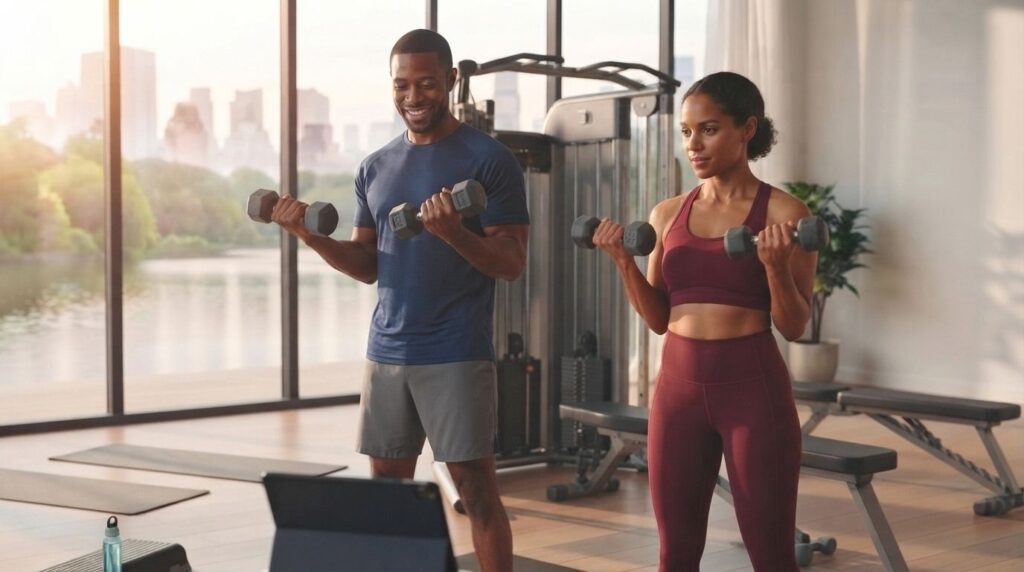
A dumbbell workout is a workout routine that includes handheld weights called dumbbells for strength training, weight loss, muscle building, and improvement of balance.
Table of Contents
Dumbbells are usually held in each hand and typically used alone or with an adjustable bench for workout diversification.
Unlike barbells, dumbbells can be used independently of each other. Hence, they are flexible, and a single dumbbell can have a significant impact on the muscles in your body.
Why Dumbbells are Great for Beginners
Dumbbells are good for beginners because they are safe and easy to use, and they allow natural body movement while building coordination. Beginners can have the opportunity or freedom to start with a weight that is suitable for them.
With a single or a pair of dumbbells, beginners can do so much with them. They can do isolation movement exercises such as bicep curls to compound workouts like squats or overhead press.
When combined with an adjustable bench, there will be a lot more options for workouts beginners can do.
The word is versatility; dumbbells are versatile and great for beginners.
Benefits of Strength Training with Dumbbells
Dumbbell workouts improve muscular imbalances through unilateral workouts while building lean muscles and boosting resting metabolic rates that, in turn, burn fat.
Additionally, they help with improving joint mobility, bone density, and stabilizer muscles that are responsible for overall balance.
Why Beginners Should Start With Dumbbells
Builds Full-Body Strength
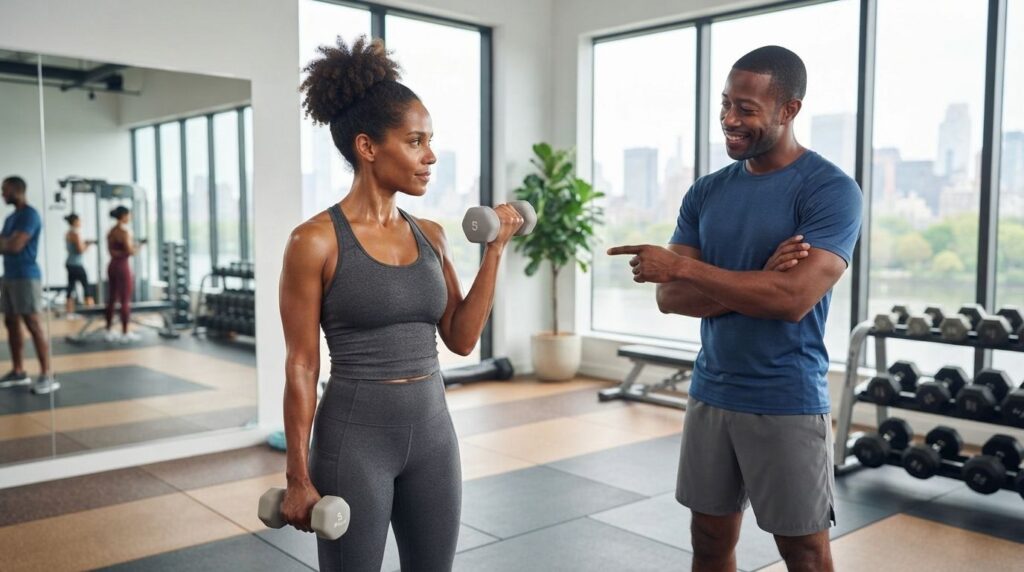
The reason why beginners should start with dumbbells is that they are the perfect tools for building full-body strength. They are flexible to use such that beginners can naturally train and exercise their muscles evenly.
The chances of sustaining injury while using dumbbells are almost zero, unless they drop on your foot.
That said, these are other reasons beginners should use dumbbells.
- As aforementioned, dumbbells force each arm and leg muscle to be independent. The right arm cannot be doing more of the lifting than the left arm, as is the case when using a barbell, where the stronger arm will be augmenting the weaker arm, which often results in one developed muscle and one underdeveloped muscle. So, dumbbells fix left and right arm imbalances.
- When using large workout equipment like a home gym, your arms and legs are often forced to move as the machine dictates. But dumbbells allow free movement of the arms and legs so that you can work on your coordination and balance while targeting the muscles of the body.
- Dumbbells offer progressive overload. This means the weight of a dumbbell can be altered, increased, or decreased. So, a beginner can start with a light weight and increase weight further when they are ready to do so. This progressive overload has an immense positive result in developing strength and muscles
- The use of dumbbells impacts the core (abdomen). Each time you try to lift a dumbbell for a bicep curl, the core is engaged to keep you balanced. Hence, the core and back are strengthened.
- A pair of dumbbells is capable of working on most of the body muscle groups. Thus, they are versatile. With a pair of dumbbells, one can work on their arm, leg, back, chest, calf, thigh, and shoulder muscle groups.
Supports Healthy Weight Management
Exercising with dumbbells builds lean muscle, which in turn boosts or increases resting metabolic rate (the rate the body burns while at rest).
Also, strength training with dumbbells burns fat while strengthening and building muscles. Lifting dumbbells and exercising with them is a kind of work. For instance, doing squats and overhead presses tends to burn more fat in the hours that follow.
When you use dumbbells for exercise, it will get to a point where you will be more likely to walk instead of using any form of transportation and climb the stairs instead of using the elevator because lifting weight has made it easier, and these activities burn fat.
Increases Bone & Joint Strength
Dumbbell exercises improve bone density, making it difficult for bones to break. At the same time, they strengthen muscles, ligaments, and joint tendons.
This is how it works: lifting weights such as dumbbells puts safe and healthy stress on the bone, challenging it to become denser over time to handle more weight. When the muscles pull firmly on the bones while lifting weight, it signals to the body for more minerals such as calcium for the bone. This process strengthens the bone even further.
Essential Equipment You Will Need
Choosing The Right Dumbbell Weight
As a beginner, choosing the right dumbbells depends on your goals and strength. In other words, which muscle groups do you wish to target or develop?
Generally, 2.5 lb. to 10 lbs. dumbbells are usually ideal for beginners’ upper body workouts, and 10 lbs. to 20 lbs. For lower body exercises.
Adjustable vs. Fixed Dumbbells
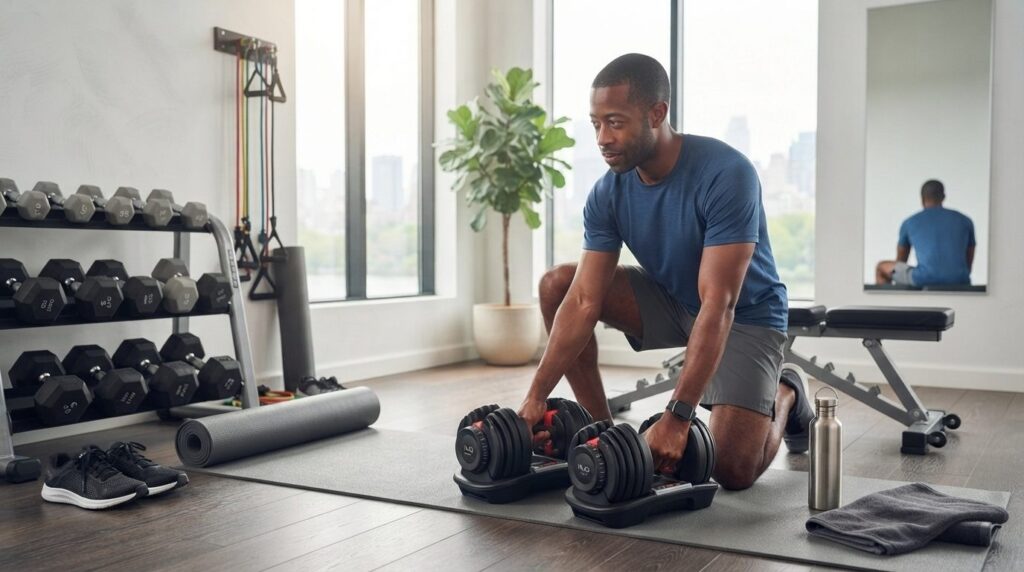
Let’s understand what adjustable and fixed dumbbells mean. Adjustable dumbbells are those dumbbells that can be adjusted. The weight on them can be increased or decreased without having to change the complete dumbbells. There will be a variety of spare dumbbell plates with different weights.
On the other hand, a fixed dumbbell is a dumbbell that cannot be adjusted by design. To put it differently, the weight cannot be increased or decreased. It is as simple as that.
As for which one is good for beginners depends on the situation. However, adjustable dumbbells will save cost and storage space because you don’t have to acquire multiple different sizes of dumbbells; instead, a pair with extra weights will do.
Other Helpful Workout Accessories
Other helpful workout accessories for beginners would be good gym shoes, shorts, a shirt, ear pods for music while you exercise, and probably a fitness tracker, and more.
The importance of any of these accessories depends on your goal and where you are training (whether at home or at the gym).
There might be a need for resistance bands, adjustable benches, medicine balls, and kettlebells. Again, it depends on your goal and budget as well.
Safety Tips Before You Begin
Warm-Up Properly
The need for warm-ups before workouts cannot be overemphasized. This prevents injury and helps beginners remain consistent in their pursuit of a better fitness level.
Warm-ups boost blood circulation and muscle temperature, hence getting the body conditioned and ready for proper workouts. Also, they enhance mental preparation and activate muscle groups.
Learn Correct Exercise Form
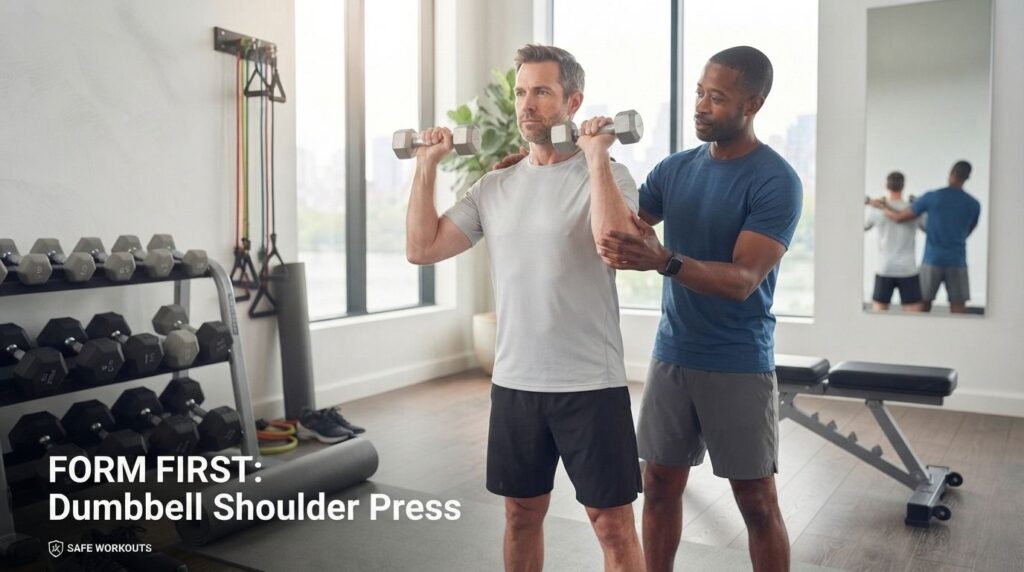
Learning the correct exercise form can eliminate a lot of problems that include injury and frustration. Not exercising in the correct form can impede your workout progress or even end it.
The better your form, the better the result. It is better to lift lighter weight and fewer repetitions with a better form than to lift heavier weight and more repetitions with a bad form.
Start With Light Weight
As a beginner, starting with light weight gives you control over the success level of your workouts because you will be able to work out with the proper or correct exercise form. Chances of getting injured are reduced, and muscle engagement is increased.
As you progress in strength, you can gradually increase the weight you use for exercise.
Focus On Controlled Movements
Mastering your workout movements gives you control over the outcome and result of your exercise. Over time, this mastery will translate to lasting strength and muscle development.
Controlled resistance, proper alignment, and joint-friendly mechanics build balance, muscles, support bone density, and improve confidence in staying active.
Know When to Rest
Doing everything in moderation with respect to your fitness goal can go a long way to produce the desired result.
Hence, knowing when to stop and take a rest is crucial to your success.
Listening to your body and knowing when it is time for rest and accordingly doing so helps to keep you on the path to success without having to deal with injuries or burnout.
When you feel physically and mentally drained, it is time to take a break and rest! No buts, or excuses, rest. When you feel sluggish and unmotivated, take some fresh air and a walk; that might help.
Beginner Dumbbell Workout Routine
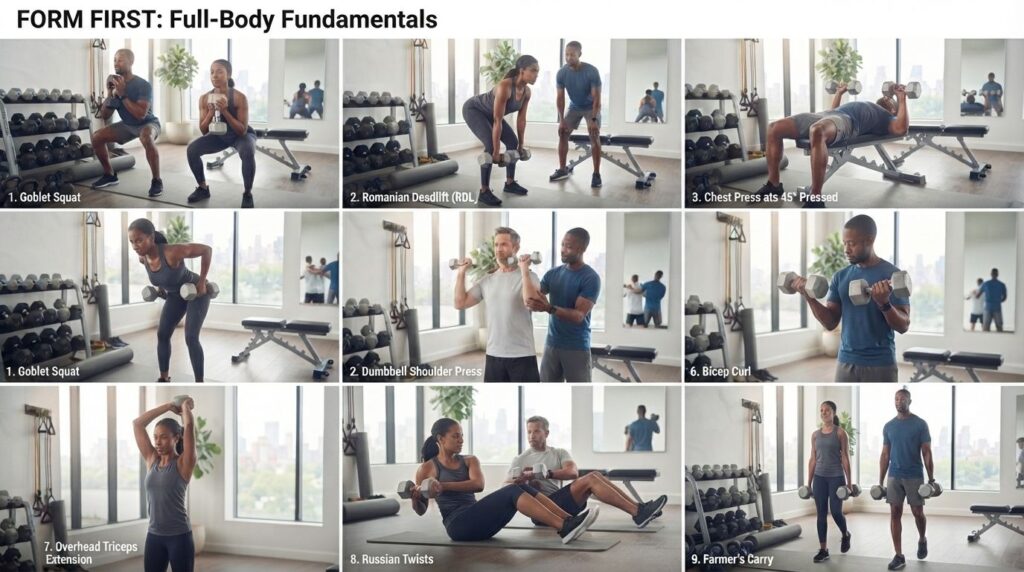
Goblet Squats
Goblet squats are beginner-friendly because they are easy to do and master. They also exert more impact on the core, hence strengthening it.
Click here for more on goblet squats.
Dumbbell Romanian Deadlifts
Individuals at most fitness levels can do the dumbbell Romanian deadlifts and benefit from them. This type of dumbbell exercise allows each side of the hip to move and work independently. It improves balance on each side while it increases the strength of the hamstrings.
So, beginners can start with a light weight to get the correct form and increase weight as they progress. It is also easy to learn.
Dumbbell Chest Press
Dumbbell chest press is particularly good for beginners because it makes each arm work independently, forcing the muscle groups for the chest, forearm, shoulders, and triceps to work harder to control and balance the weight. As a result, the muscle groups have a fair share of the weight that will build and strengthen them, especially at the development level.
One-Arm Dumbbell Rows
One-arm dumbbell rows allow beginners to use lighter weights for workouts, hence enabling them to start somewhere. Just like the dumbbell chest press, it is done in combination with a bench but particularly builds and impacts the back.
Standing Dumbbell Shoulder Press
Standing dumbbell shoulder press helps beginners work out in proper or correct form for the same reason that has been reiterated in this article. The dumbbells put equal weight on each arm, hence building and strengthening them equally and creating a balanced physique.
Moreover, beginners can start and adjust their weight to the ideal level that is suitable for them to move forward and develop.
Dumbbell Farmer’s Carry
Dumbbell farmers’ carry is considered one of the most effective workouts that can be done by beginners. It is good at targeting and strengthening the core, hips, grips, and it relieves back pain.
So, part of the reason it is good for beginners is that it is easy to learn and has low chances of an injury.
Dumbbell Bicep Curls
Dumbbell bicep curls are an entry-level workout for beginners. It builds the upper body muscles such as the arms and the biceps. Again, it allows independent arm movement that forces the muscle groups to work harder for better results.
Dumbbell Triceps Extensions
This exercise helps beginners to build bigger arms, triceps, and even the core with just dumbbells. Well, maybe a bench too. There are variations of dumbbell triceps extensions that include overhead triceps extensions. This could be done while sitting or standing, with both arms or a single arm, which is also referred to as the one-arm overhead dumbbell triceps extensions.
The lying dumbbell triceps extensions have two variations: the standard lying and the crossbody lying posture/technique, and they are good for beginners.
Dumbbell Russian Twist
In a single and simple motion, the dumbbell Russian twist exercise strengthens the core and stability, hence good for beginners. Watch this video.
Sample of Full-Body Beginner Workout Plan
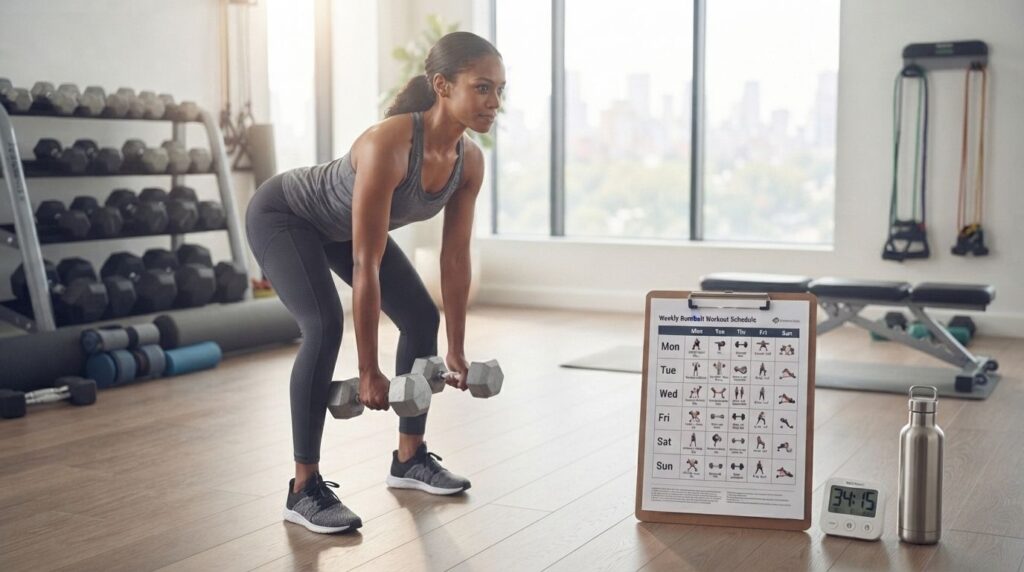
Workout Structure (Sets, Reps, and Rest)
When beginners get the best workout structure, they will have a fitness workout compass they can follow. By doing so, things won’t be complicated for them as they pursue their fitness goals.
That said, 3 sets of 8 to 12 repetitions per exercise will be fine, and rest for 60 to 90 seconds before moving into another set. This helps to prevent injury or soreness while building muscles as intended.
3-Day Weekly Beginner Workout Schedule
It is good for beginners to engage in full-body workouts every other day of the week for three days.
It is important to always skip a day before exercising again. For instance, it can be like exercise on Monday, Wednesday, and Friday.
On each day, do different full-body workouts. For example, Day 1: dumbbell or goblet squat, dumbbell bench press, lat pulldown or pull-ups, and planks (3 sets of 30 seconds hold).
Day two: do dumbbell Romanian deadlifts, seated cable row, seated dumbbell shoulder press, and dead bugs
Day three: reverse lunges or leg press, incline dumbbell press, cable face pulls, and dumbbell bicep curls.
Remember to use the 3 sets, 8 to 12 repetitions, and 60 to 90 seconds rest between exercises formula.
Cool Downs & Stretching Routine
At the end of every workout session, cool downs and stretching should be observed. This is done to prevent muscle stiffness and also bring the heart rate back to normal.
Light walking and stretches such as standing quadriceps stretch, hamstring stretch, butterfly groin stretch, triceps stretch, arms cross over stretch, and child pose stretch can help to make you feel comfortable.
Common Beginner Mistakes to Avoid
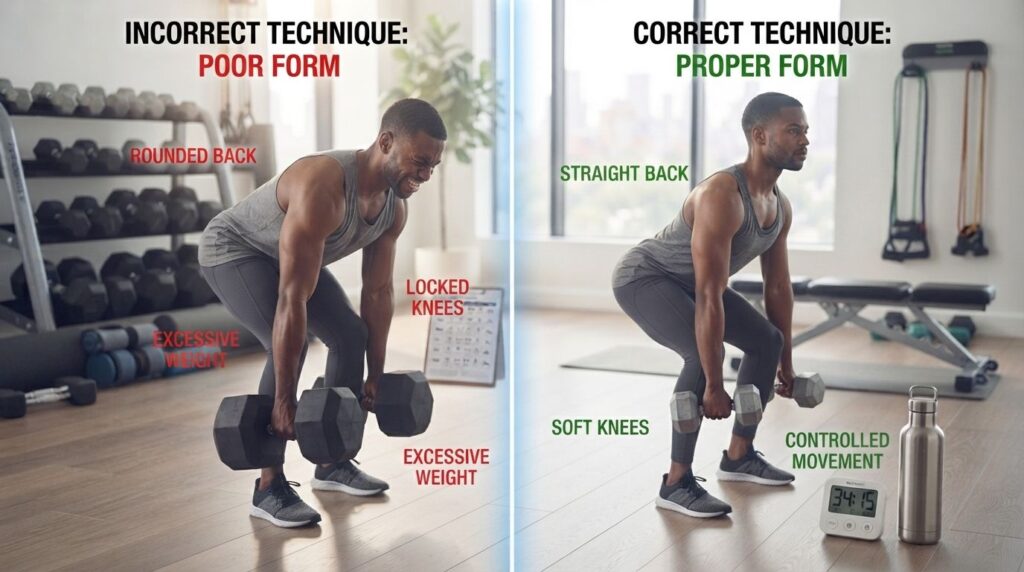
Using Weights That Are Too Heavy
As a beginner, using weight that is too heavy only hurts your goal of succeeding. Using heavy weight puts you at risk of getting injured due to poor posture, and you may not be able to work out longer or meaningfully as you should.
Pick a weight that will allow you to finish 8 to 12 reps without breaking your correct form. If it breaks, then know that the weight is too heavy for you.
Skipping Warm-Ups & Cool-Downs
Beginners often make the mistake of not warming up before workouts and cooling down after workouts. This can derail your effort to achieve your fitness goals because it can cause injury, muscle soreness, and poor performance.
A few minutes of warm-ups and cool downs can go a long way to make your workout routine more effective and productive.
Rushing Through Repetitions
Beginners must not rush through repetitions because your fitness goal is not all about how many repetitions you are able to make but the quality of your workout and performance.
Rushing through repetitions can make you work out with poor or incorrect form, which may lead to injury. Moreover, relying on momentum produces low performance at the end of the day; you may see little or no results.
Slowing down and correctly performing your workouts forces the muscles to work harder for better outcomes.
Ignoring Proper Breathing
As simple as it may sound, ignoring proper breathing before, during, and after workouts can cause rapid fatigue, dangerous blood pressure spikes, and dizziness.
Proper breathing not only supplies the muscles with much-needed oxygen for energy, but also prevents injury because it serves as a natural brace for the spine and the core.
Not Allowing Enough Recovery Time
Ignoring or not allowing enough recovery time sabotages your workout journey and effort. Instead of becoming strong and healthier, you will be experiencing fatigue, injury, pain/soreness, poor sleep, and poor workout performance.
Always work out every other day; in other words, at least skip a day for rest before your next workout session. This allows the body and muscles to recover, reboot, heal, or refresh from the previous workout session.
Feelings that may indicate that you are not getting enough rest time might include lingering muscle pains, sickness, change in weight, poor sleep, low motivation to exercise; even when you do, you will tend to be slower or lift lighter weight, feeling of anxiety, and moodiness, etc.
Who Can Benefit from Beginner Dumbbell Workouts
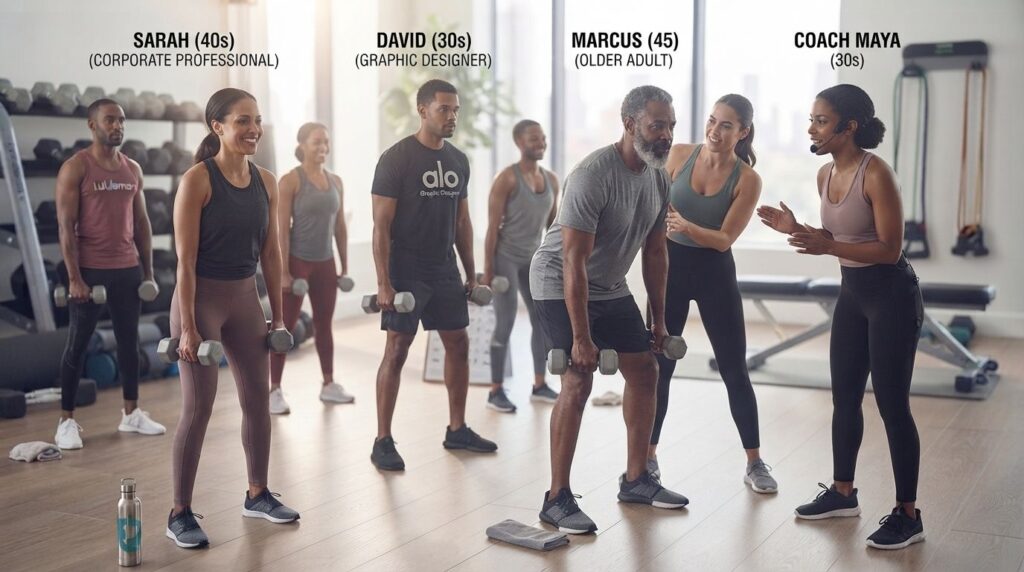
Complete Fitness Beginners
People who have never tried working out before will benefit from beginner dumbbell workouts. The reason is that dumbbell workouts allow complete control of the movements of the body, arms, and legs.
They are also cheap to acquire and can be used to do a variety of different full-body workouts with low risk of injury. Hence, beginners will be able to progress in their fitness journey and see results over time.
People Exercising at Home
Beginner dumbbell workouts allow people exercising at home to fully exercise the whole body. This brings gym experience right to their doorstep even though they are only using dumbbells to exercise.
Adults Looking to Build Strength
Dumbbell workouts are versatile and great at building strength. For instance, dumbbell bench press builds the chest and arms, goblet squats build the legs and the core, bent-over row builds the back and posture, and standing overhead press builds the shoulders
Older Adults Starting Resistance Training
Beginner dumbbell workouts are perfect for older adults because they help improve strength, balance, build muscles, and even lose weight through increased resting metabolic rate.
Dumbbells are handy; they don’t require so much preparation to get on with your workouts.
Frequently Asked Questions (FAQ)
What Weight of Dumbbell Should Beginners Start With?
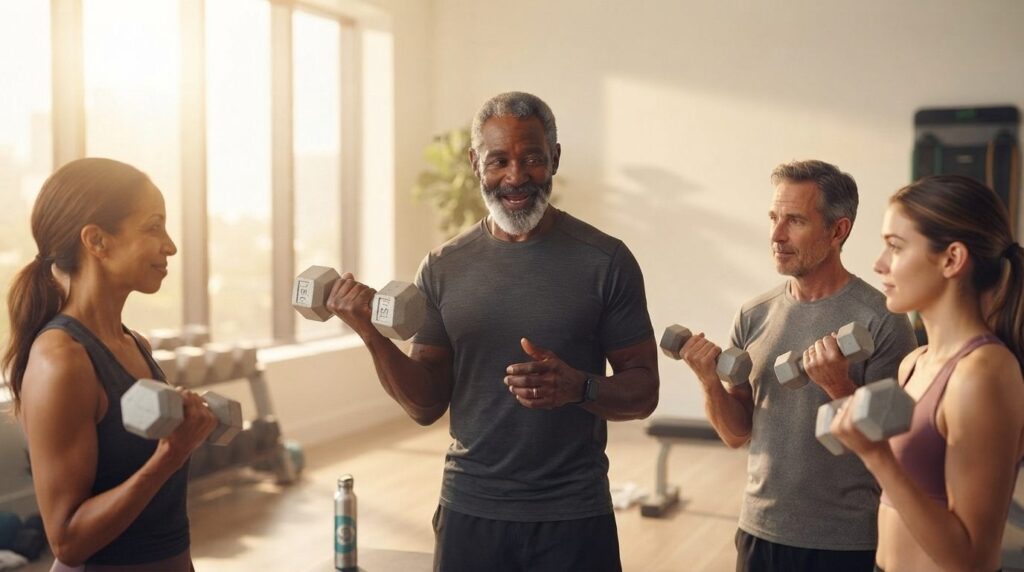
Beginners should start with the weight they are comfortable with and at the same time a bit challenging. However, any weight that would make them not exercise in a proper form is probably too heavy for them.
Ideally, beginners should start with 2 kg to 5 kg (5 lbs. to 12 lbs.)
How Many Days a Week Should Beginners Do Dumbbell Workouts?
Beginners should do 2 to 3 days a week of full-body dumbbell workouts. Ensure you have a full day of rest between workout sessions for muscle recovery or healing.
Can Beginners Build Muscles with Dumbbells Alone?
Yes, beginners can build muscles with only dumbbells. The reason is that dumbbell workouts are resistance or strength training, and they put pressure on the muscles. Hence, the muscles develop overtime of consistency.
Moreover, since a beginner is new to workouts, their muscles tend to respond or develop faster.
How Long Should a Beginner Dumbbell Workout Last?
To build a solid foundation and avoid overtraining, a beginner dumbbell workout should last for 20 to 45 minutes. This includes the warm-ups and cool-downs time as well.
Is it Okay to Do Dumbbell Exercise Every day?
No, not recommended. This is the reason it is advised to work out every other day, to allow at least 24 hours of rest for body and muscle recovery. Sometimes, it takes about 48 hours to 72 hours for the body to fully recover. This helps your muscles heal and get stronger.
Conclusion
Take it easy when trying to build strength and muscles with dumbbells. No rush; adhere to the proper form and weight that you lift. Gradually increase the weight as your strength and muscles improve.
Be consistent and enjoy your fitness journey.

I take anything and everything that improves my health seriously. Hence, I try to share my knowledge to help people who wish to improve their health status to one that enables them to live strong with confidence We also review health and fitness equipment such as treadmills, elliptical trainers, spin bikes.